
back to 12.2
 A Dark Reflection: The Devil Personified in “Striking Vipers,” “San Junipero,” and “Demon 79”
by Claire Gordon
Both tarot and Black Mirror are social commentaries that use subversive images and symbols to spark personal reflection. Black Mirror does not only inspire debates around continual technological advancement, but also promotes personal queries around morality, human desire, and the ripple effect of daily actions in one’s seemingly personal, private life. The series explicitly draws attention to damaging and arbitrary social rules and norms influenced, or caused, by “technologies that are already widely used…These parallels between Black Mirror and the current reality have hardly gone unnoticed” (Duarte 11). In an interview with Total Film, Black Mirror creator Charlie Brooker explains that it’s not the technology itself that is corrupt, but the people who use it: “There was a slight danger… that people were bracketing [the series] as the ‘tech is bad’ show – and I found that a bit frustrating partly because I always felt like, ‘Well the show isn’t saying tech is bad, the show is saying people are fucked up.’” From smartphone screens to actual mirrors, Black Mirror is filled with reflective mechanisms. Specifically, when demonic images that mirror the illustration on the Rider Waite Smith tarot card, the Devil, appear, Black Mirror characters are depicted as immersed in temptation, deceit, and indulgence.
While there is a plethora of research and literature analyzing images, qualities, and symbology of the devil, there is a gap in research connecting this knowledge to Black Mirror. The episodes “Striking Vipers,” “San Junipero,” and “Demon 79” utilize images and symbols that correlate with the devil as a visual means to reflect the darker sides of reality. In a similar way to the esoteric interpretation of the Devil tarot card, demonic symbolism in these episodes picture the catastrophic effects that take place both socially and personally when there is not an internal balance of pleasure and addiction. According to Inna Semetsky, tarot’s “pictorial symbolism embodies intellectual, moral, and spiritual ‘lessons’ constituting collective human experiences across times, places and cultures,” (Semetsky “Transforming” 106). A traditional deck of tarot cards consists of 78 cards divided into two categories and four sub-categories: the major arcana and the minor arcana of wands, swords, cups, and coins (also known as pentacles). Over the centuries, the cards have become associated with fortune telling. Their symbolism, however, correlates to the subconscious and implicit “archetypes of the collective unconscious,” (Semetsky, “Interpreting” 106).
Tarot has historical and, in the case of the Rider Waite Smith deck, visual associations with the Torah and the New Testament. Gerhard Jaritz notes that ancient Christian art portrays the devil with an “unpleasant appearance,” with weapons such as “clubs, sticks, ropes, chains…etc.” (55). Both the devil in Christian myth and the Devil card in the tarot picture a demon in a variety of non-human forms, drawing on animalistic body parts like horns, tails, wings, claws, and hoofs. Jaritz explains that this visual disorder indicates “restless, irregular, unpredictable movement” (30). Additionally, the devil is historically sketched dominating or intimidating other characters and people. The devil, argues Jaritz, is “a mental construction. The devil’s visual proximity…is symbolic proximity” (59). In other words, the closer that the visual representations of the devil appear in relation to characters on screen in Black Mirror, the deeper they are in the realm of vice and fixation.
“Striking Vipers” pays particular attention to over-indulgence and shows the damage that can happen when one spends too much time flirting with temptation. Danny and Karl both actively engage in a willful ignorance that almost destroys both Danny and Theo’s marriage and Karl’s life satisfaction outside of the virtual world of Striking Vipers X. Scholar Amanda Cote argues that “technoculture and interactive gaming has given people the opportunity to ‘try out new identities without the costs of doing so in real-life,’” (qtd. in Alaoui 193). But Alaoui fails to address the harm that Danny and Karl’s virtual relationship causes in the real world, which is the near dissolution of a family. It is not Danny’s sexual curiosity and desire that is damaging, but rather it is his intentional verbal deception in communications with Theo that fractures their bond. While dining out on their wedding anniversary, Danny lies to Theo, saying that there’s no one else: “Nothing is going on. I promise. I swear” (00:40:30-37).
Moreover, Danny and Karl “can navigate queerness by experiencing their most intimate fantasies and desires within their own set boundaries” (Alaoui 194), but Theo is excluded from any decision making within the parameters of their relationship and is effectively left powerless. There is a striking resemblance to the first glimpse the viewer gets of Lance and Roxette in the original Striking Vipers and the Rider Waite Smith depiction of the Devil tarot card: a dark, mysterious space, a woman on the left and a man on the right, both trapped in fire and chains as bondage (00:04:56). Hovering behind them are watchful eyes, which could be symbolic of Danny and Karl’s conscience: “The Devil card represents your shadow (or darker) side and the negative forces that constrain you and hold you back from being the best version of yourself. You may be at the effect of negative habits, dependencies, behaviors, thought patterns, relationships, and addictions” (“Devil Tarot”). The bondage that physically restrains the people in the Devil card appears loose, as though they could easily slip the chains over their heads and off. But first, they must recognize and address the environment that enslaves them. Without acknowledging that Striking Vipers X is creating a dishonest situation that excludes Theo, Danny, and Karl’s exploration of their sexual desire for each other becomes deceptive.
Although unintentional, Theo is not completely passive in Danny and Karl’s budding romance. She believes that they are still good friends, and as she witnesses Danny withdraw, she invites Karl into their reality in an effort to support her husband: “Speak of the devil,” (00:45:55), she says before opening the door to let Karl into their home for Danny’s birthday dinner. Striking Vipers draws attention to the subtle nature of temptation by showing seemingly out-of-place scenes where Danny is shot with an aloof expression gazing at women. First, at the woman’s exposed lower back at his birthday party (00:08:50), and later, the day after Danny and Karl’s virtual first kiss, Danny gawks at a stereotypically attractive woman getting into her car (00:23:18). It is unclear whether Danny is fantasizing about the women he stares at or deep in an alternate reality. Regardless of a change in plot, these scenes suggest that if Karl had not gifted Danny Striking Vipers X, Danny may have still deceived Theo and jeopardized their marriage through alternative means.
In contrast to “Striking Vipers,” “San Junipero” sketches the importance of pleasure, connection, and expression through sexuality. In Black Mirror’s futuristic episode, senior citizens have the opportunity for one last chance to explore their passionate curiosities in their young bodies. San Junipero’s dark bar, the Quagmire, is a consensual place for the dying to experience unfulfilled kinks from life in the real world. In this way, a visit to the Quagmire can shed and transmute contempt or guilt around sexuality that the characters may be carrying. Like the Devil card, the Quagmire shows humans in bondage and guises exploring various forms of desire, sexuality, and sometimes, overindulgence. Indulging in fantasy and fetish can be an enriching aspect of the human experience, and like many pleasure-seeking activities, too much can create “the potential to turn into something that may be unsafe or detrimental to your well-being in the long-term” (“Devil Tarot”). Unlike Danny and Karl, who become completely immersed in the fulfillment of their sexual desires in the world of Striking Vipers X, Yorkie explores the Quagmire with caution and appears afraid to stay too long. She does, however, enter and exit the space by her own free will, arguably witnessing the Quagmire as “the evil twin of Tucker’s, a place of extreme entertainments that seems to be designed to provide one last chance for those who have failed to find fulfillment in the more wholesome environment of Tucker’s” (Daraiseh and Booker 158).
Like many who visit the dark bar, one of the reasons Yorkie has come to San Junipero is to experience her unattained sexual desire: intimacy with a woman. Likewise, Kelly visits both Tucker’s and its “evil twin” (158) to enjoy the parts of her sexual being that were unacted upon during her lifelong marriage to Richard. But even after death in the fun, free-loving San Junipero, some form of moderation appears to be necessary. Just as the Devil card can show up in a tarot reading as a reminder to enact self-control, Wes appears in the episode as a ragged, drunk vision of overindulgence. He continually lusts after Kelly and cannot be satisfied by one romantic night with her, but instead attempts to bulldoze her autonomy. Wes revisits the Quagmire in a pursuit to satiate his ever-growing appetite for craving and pleasure and appears haggard when Yorkie bumps into him there (00:27:00). His character creates a contrasting vision of Yorkie and Kelly’s exploration of pleasure and trust.
“Demon 79” draws attention to the subversive and potentially all-consuming influence of the devil. Alongside typically demonical visuals such as fire, horns, and hoofs, Scholar Katherine A. Fowkes argues that the devil in film can also be akin to the trickster: “variations of the trickster abound across time and cultures, but in most cases the trickster preys upon human…weaknesses with humorous results” (58). The dramatized retro horror visuals in “Demon 79” use “the comedic approach…of the trickster whose typically marginalized status requires an understanded approach rather than an outright power grab,” (59). Before morphing into the object of Nida’s desire (Bobby Farrell in an ironic all-white angelic garb), Gaab appears (00:15:29) in Nida’s apartment as “the Devil represented in his most well-known satyr form, otherwise known as “Baphomet” (“Devil Meaning”) and also a mirror image of the Devil in the Rider Waite Smith tarot deck. Nida unintentionally rouses Gaab as she goes down to the basement of her workplace, a metaphorical exploration of the darker parts inside herself. It is there in the shadows that she “discovers a talisman with a mysterious symbol on it…a glyph that looks a bit like a tuning fork” (Lee). The symbol has three lines that connect with each other, “perhaps representing the branches of fate and the consequences of our choices”(Lee) and reflecting the interactivity of the physical, sensual, and spiritual domain encompassed within the Devil tarot card.
The narrative in “Demon 79” shows Nida as a submissive character, passively taking orders from her employer and peers. This meekness is not akin to character traits typically viewed as lateral to humility, but rather leans towards lethargy. As the show progresses, Nida begins to “behave in a neurotic or compulsive manner,” (Semetsky,“Interpreting,” 110). It becomes clear that Nida functions in the realm of extremes as she moves from spiritlessness to a passionate rage, speeding down the highway in a red leather jacket to enact her final murder: “The Devil card” can appear “when you are going into your deepest, darkest places,” (“Devil Tarot”). Prior to a reading, tarot cards are shuffled at random and placed in a particular pattern, called a spread. Alternatively, some readers choose to shuffle until a card falls out of the deck, almost as if the card itself has been chosen to be read. While it initially appears that Nida kept the talisman she found in the basement of her workplace by her own free will, perhaps, in this world of parallel universes, it was actually Gaab who summoned her: “It has to be someone corruptible,” (00:24:39-41). The humans on the Devil tarot card are bound to greater forces and their overlord wields an ultimate power over them. The Devil holds a flame close to the man’s back, symbolizing urgency and demand. Nida, similarly, is constrained to Gaab’s demands of killing three people in three days. As the woman and man on the Devil card spend more time in chains, they appear to be slowly transforming into their oppressor, illustrated by their protruding horns and tails: “the more time they spend with the Devil, the less human they become,” (“Devil Meaning”). The more time Nida spends with Gaab, the more she becomes desensitized to the killings she must intact; she eventually even falls in love with the demonic force that at first restricts her. Unlike Yorkie, who explores the shadows tentatively, once Nida tastes unlimited power, there’s no turning back.
When the devil and images related to the Devil appear, the characters in “Striking Vipers,” “San Junipero,” and “Demon 79” are lying, alone in dark spaces, or acting out devious plans. The devil “is not only alien to the order of the universe, but he also tries to destroy this order” (Jaritz 30). Each card in the major arcana is numbered and popularly read as a sequential narrative. Interpreting the Devil card deepens when the reader investigates the cards that immediately follow: the Tower and the Star. The Tower depicts two people falling, or leaping, from a burning building; it symbolizes chaos, destruction, the shattering of illusions, and starting anew. The Star card illustrates a naked woman under a night sky, surrounded by water and “is a symbol of being finally stripped of the darkness by bringing it to the level of conscious awareness,” (Semetsky “Interpreting” 116). One can see these themes subsequently following devilish instances in the three episodes discussed above. When Roxette tells Lance that she loves him (00:51:57), the false impression of reality that the gamers have created collapses. While Danny may be comfortable exploring his sexuality and desire in secret with his friend, crossing over into the realm of love poses a seriousness he was previously unwilling to acknowledge. This scene is their Tower moment which leads to Danny sharing the truth of their relationship with Theo. Just as people can “find fulfilment when they have destroyed the mask of the persona and are able to return to the ordinary world, renewed” (Pollack 110), Danny and Theo almost end their relationship, but their honesty allows them to compromise in an unrestricted way.
The Tower likewise translates into “the destruction of long established situations,” (Pollack 121) and relates to Kelly’s restrictive promise that cripples her ability to enjoy the afterlife: she will not allow herself to pass over into San Junipero because Richard and their daughter were unable to. Although Kelly marries Yorkie “as a kindness” (00:51:01) to help her pass over, Yorkie misunderstands the parameters of the marriage and asks her newly wedded wife to stay forever: “We got this chance. I want to share it with you” (00:51:21). Kelly must either leave Yorkie or embrace the metaphorical elements of the Devil “by releasing that energy we get past the barriers of repression and open ourselves to the lightening” (Pollack 120) strike of the Tower. In the end, the Tower appears as a reminder of one’s freedom to choose a different path: “the explosions are clearing away some situation that has built up intolerable pressure” (121). The Star serves as a beacon of peace, calm, and emotional freedom after the turmoil of the Tower. Kelly chooses a different path for her afterlife, effectively dismantling the constraints she and Richard have agreed upon in order to be with Yorkie.
Nida walks the fine line of vigilante hero and takes back control when she chooses her final murder victim, Michael Smart. The decision is one that she believes will enact justice. This external gesture gives her a kind of twisted confidence; she finally asserts herself to Vicky’s demanding requests and refuses to help either of them with Smart’s new shoes: “Stool’s there. Do it yourself,” (00:53:33). Nida’s Tower card moment, finding the talisman and the subsequent murders, have helped her discover her own power. For better or for worse, she is transforming – and Gaab notices it too: “You’ve changed,” (00:54:25). The Star card bolsters hope, and “the value of this archetype lies…in its power to arouse the inner self and to connect us to the source,” (Pollack 123). Although the tarot reader might generally relate the Star to qualities of tranquility, there is an ironic delight visible on Nida’s as she speeds down the highway after Smart. She may be murderous, but she is also free: “In the Star we see the inner self joyfully experiencing itself,” (Pollack 124). Nida’s entire world must collapse before she can finally find her voice, confidence, and sense of self. In practice, “Tarot brings to our awareness many initially unperceived meanings, thereby contributing to human learning and development based on both actual and potential experiences,” (Semetsky, “Transforming,” 110). Ultimately, like the tarot cards, Black Mirror reflects ethical dilemmas back to the viewer and invites one to analyze themes such as temptation, deceit, and indulgence.
Appendix A: The Devil, The Tower, and The Star cards from the Rider Waite Smith tarot deck

Semetsky, Inna. “Interpreting the Signs of the Times: Beyond Jung.” Social Semiotics, vol. 20,
no. 2, 2009, pp 111. Taylor & Francis. https://doi-org.ezproxy.viu.ca/10.1080/10350330903565600
Appendix B: Striking Vipers in “Striking Vipers”
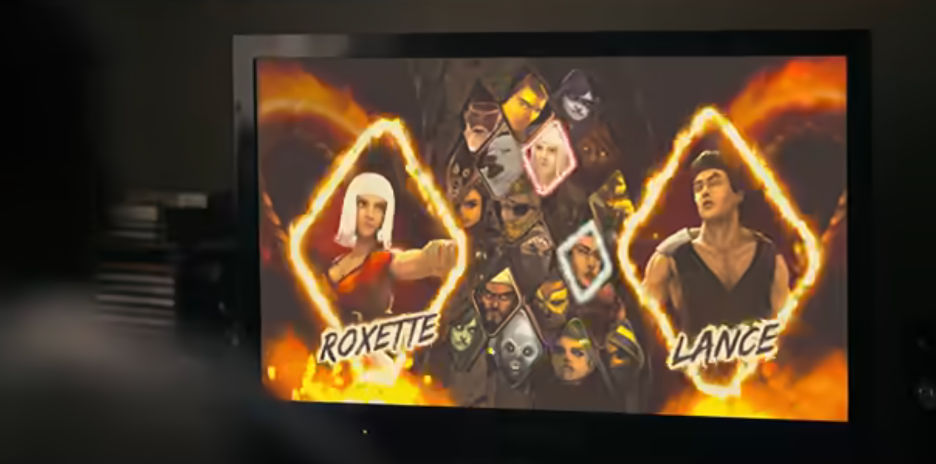
“Striking Vipers.” Black Mirror, created by Charlie Brooker, season 5, episode 1, Channel 4,
2019, Netflix.
Appendix C: Yorkie’s visit to the Quagmire in “San Junipero


“San Junipero.” Black Mirror, created by Charlie Brooker, season 3, episode 4, Channel 4,
2016, Netflix.
Appendix D: The devil as Baphomet in “Demon 79”
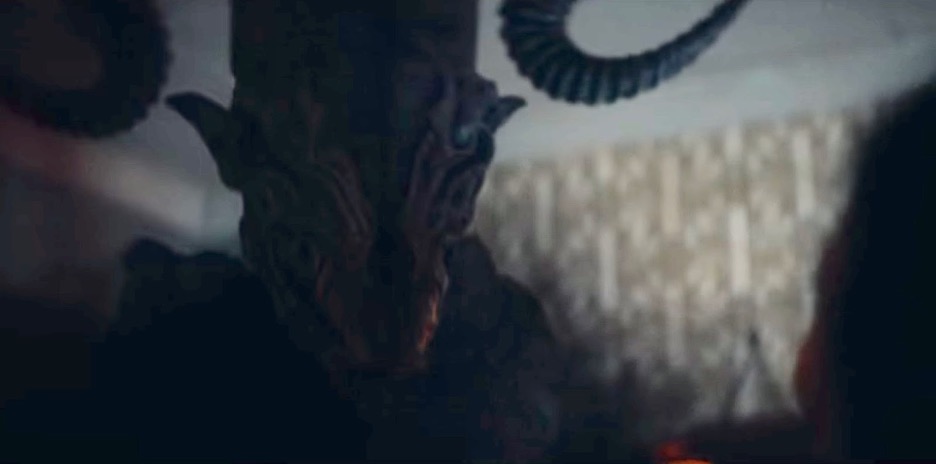
“Demon 79.” Black Mirror, created by Charlie Brooker, season 6, episode 5, Channel 4, 2023,
Netflix.
Works Cited
Alaoui, Fatima Zahrae Chrifi. ““You Know It’s Different in the Game Man”: Technodesiring,
Technorelating, and TechnoBlackness as Analytical Modes of Queer Worldmaking in Black Mirror’s, “Striking Vipers”,” Journal of Homosexuality, vol. 70, no. 1, 2023, pp 192-209. Taylor & Francis. 10.1080/00918369.2022.2103876.
Daraiseh, Isra, and M. Keith Booker. “Unreal City: Nostalgia, Authenticity, and Posthumanity
in “San Junipero.” Through the Black Mirror:Deconstructing the Side Effects of the Digital Age. Edited by Terence McSweeny and Stuart Joy. Springer International Publishing AG, 2019, pp 151-63. ProQuest Ebook Central, https://ebookcentral.proquest.com/lib/viu/detail.action?docID=5841318.
“Demon 79.” Black Mirror, created by Charlie Brooker, season 6, episode 5, Channel 4, 2023, Netflix.
“The Devil Meaning – Major Arcana Tarot Card Meanings.” Labyrinthos LLC. 2023.
https://labyrinthos.co/blogs/tarot-card-meanings-list/the-devil-meaning-major-arcana-tarot-card-meanings.
“The Devil Tarot Card Meanings.” Biddy Tarot. 2023.
https://www.biddytarot.com/tarot-card-meanings/major-arcana/devil/.
Duarte, German A., and Justin Machael Battin. Reading »Black Mirror« : Insights into
Technology and the Post-Media Condition. transcript, 2021. ProQuest Ebook Central, https://ebookcentral.proquest.com/lib/viu/detail.action?docID=6508017.
Fowkes, Katherine A. “What’s the Deal with the Devil? The Comedic Devil in Four Films.”
Giving the Devil His Due. Fordham University Press, 2021, pp 58-70. JSTOR, https://doi.org/10.2307/j.ctv1zm2tb9.
Jaritz, Gerhard. Angels, Devils : The Supernatural and Its Visual Representation. Central
European University Press, 2011. ProQuest Ebook Central, https://ebookcentral.proquest.com/lib/viu/detail.action?docID=3137317.
Lee, Stephan. “How Does That Rule-Breaking Black Mirror Episode ‘Demon 79’ End?” Tudum By Netflix. 2023. https://www.netflix.com/tudum/articles/black-mirror-demon-79-ending-explained.
Mellor, Louisa. “Black Mirror Season 6 Episode 5 Review: Demon 79.” Den of Geek!, 2023.
ProQuest, https://ezproxy.viu.ca/login?url=https://www.proquest.com/magazines/black-mirror-season-6-episode-5-review-demon-79/docview/2825955013/se-2.
Pollack, Rachel. Seventy-Eight Degrees of Wisdom: A Tarot Journey to Self-Awareness.
Newburyport, MA, Weiser Books, 2019.
“San Junipero.” Black Mirror, created by Charlie Brooker, season 3, episode 4, Channel 4,
2016, Netflix.
Semetsky, Inna. “Interpreting the Signs of the Times: Beyond Jung.” Social Semiotics, vol. 20, no. 2, 2009, pp 103-20. Taylor & Francis. https://doi org.ezproxy.viu.ca/10.1080/ 10350330903565600.
Semetsky, Inna. “Transforming Ourselves/Transforming Curriculum: Spiritual Education and
Tarot Symbolism.” International Journal of Children’s Spirituality, vol. 14, no. 2, 2009, pp. 105-20. Taylor & Francis. https://doi-org.ezproxy.viu.ca/10.1080/13644360902830192.
“Striking Vipers.” Black Mirror, created by Charlie Brooker, season 5, episode 1, Channel 4,
2019, Netflix.
West, Amy. “Charlie Brooker Doesn’t Want Black Mirror to Be Known as the ‘Tech is Bad’
Show Anymore.” Total Film. 2023. https://www.gamesradar.com/black-mirror-season-6-charlie-brooker-jessica-rhoades-interview/.
—
Claire is a recent graduate from Vancouver Island University with a major in English. Her writing is informed by feminist and ecocritical perspectives and has appeared in Queen City Writers, Portal Magazine, Canadian Yogi, and Sea & Cedar Magazine.
 queen city writers
You must be logged in to post a comment.