

An Appetite for Words: Developing My Literacy Palate
by Maggie Sheridan
To tell the story of my literacy, I have to start with toast. “Toast” is one of those special words that embodies its meaning: the t’s, crisp but not hard, border the middle three letters like crust, while the oa sound in tandem with the sibilant s signals dry, porous crunchiness. Putting all the parts of the word together magically reproduces the sensation of masticating the dehydrated flour-and-grain matrix that is toast. Phonic-semantic harmony aside, the real reason I mention toast is its connection to my reading chair.
My house contained a hodgepodge of chairs, from the faded blue recliner in the living room to the wooden round-backed swivel chairs in the kitchen (chipped from my sister and I swiveling them right into the counter) to the simultaneously stuffy and understuffed chairs in the dining room. The most important chair — my reading chair — was in the playroom. Vertical stripes of irregular widths wrapped around the chair’s body in three main hues: navy blue, the warm golden-brown of toast, and the placid burgundy of strawberry jam. It was an odd color scheme — nothing like the specimens that grace the pages of Better Homes and Gardens — and I am convinced that the chairmakers snuck in navy blue only to make the furnishing less toast-like. But considering that bread has been a dietary staple for thousands of years, and that strawberry jam appealed to my sweet tooth, the chair and I got along quite nicely. Surrounded by imaginary stacks of jam-smeared toast, I would read in the chair for hours upon hours. Even the feel of the weave against my skin recalled the matte texture of a napkin or tablecloth. The fusion of my reading place with an eating place was no accident, evidenced by the phrases “voracious reader” and “sink your teeth into a book.” These sayings speak the truth of books as nourishment, as fuel for our mental muscles. So it was that each time I settled into the chair, I was treated to a magnificent feast of words.
About six feet away from the reading chair was a set of French doors. When I was small, my parents taped index cards with the letters of the alphabet onto each pane, and it was here that I nibbled at the first morsels of my literacy. Stoked by the radiance of A to Z, my inchoate interest in words sprung forth like toast from the toaster. Once I could read the letters, I could read sight words, and once I could read sight words, I proceeded to read anything and everything: books, newspapers, store circulars, DVD cases, road signs, cereal boxes, and, in one amusing instance, a blender manual. Like many children, I would read aloud, savoring the sounds of the words. I shooed away my mother whenever she came in the room to listen — I wanted to have my cake and eat it too, by myself, thank you very much. After I started silent reading, the words were that much more delicious, a fully private enjoyment.
Between kindergarten and first grade, apparently bored with the typical children’s books, I decided to tackle my father’s sixteen-volume Golden Book Encyclopedia set. I remember being enraptured by the glossy pages, colorful illustrations, and bolded words that studded the books’ interiors like gemstones. Similar to Malcolm X “riffling uncertainly through the dictionary’s pages” (2), the vocabulary was too advanced for me. Nevertheless, I doggedly read on, and even though I didn’t comprehend the words, I stored them in my mind. I know this because they later cropped up in my first-grade journal. One sheet is drizzled with a spray of words including “encyclopedia” itself, “solar system,” “electron,” “Ice Age,” “volcano,” and “Greece.” Another two words are “outsmart” and “challenge,” an intimation that this precocious, pint-size pupil, explorer of encyclopedias, was ready to school school.

Following this seminal literacy event, I continued to expand my vocabulary — my taste in language — and I would drop piquant words in writing with the eagerness of a chef presenting his course. For example, when I had to explain how I solved a logic problem in fifth grade, I talked not of finding the answer, but “extricating” it. I didn’t think I was being pedantic (in fact, “pedantic” was not yet in my vocabulary) but inventive. Sherman Alexie, recalling how he willfully defied low academic expectations by consistently reading well above grade level, identifies himself as “arrogant” (365). I, too, marched to the beat of my own drum: I had an unshakeable conviction in my skill with words, youth and inexperience be darned.
When I wasn’t testing my novel vocabulary at school, I was curled up with a book in the reading chair. (Instead of sitting, I would lie across the chair such that my shoulders were braced against one arm and my legs dangled over the other arm, not unlike the way I imagine my mother used to hold me in her arms.) The chair was my “far-seeing place” (King 103), where I could observe astonishingly diverse worlds projected from the writers’ imaginations. Of course, since the reading chair was the toast-and-jam chair, reading was not just a visual but a gustatory experience. I appreciated the individual flavors of words and how they came together in complex interactions. Words were the medium through which larger devices — plot, characters, setting, and tone — were assembled, and an author would then utilize these devices to form a distinct flavor profile. For example, the Redwall series by Brian Jacques was like a Thanksgiving turkey: meaty, comforting, homey. Amid Jacques’ lush, truly sublime descriptions of food and nature, friendly animal characters embark on grand adventures. Meanwhile, Lemony Snicket’s A Series of Unfortunate Events had the bittersweet essence of dark chocolate, underlaid with citrus (“Lemony”) notes from Snicket’s tart wit. Snicket narrates the travails of the Baudelaire orphans, who are on the run from their greedy Count Olaf while enmeshed in the dramas of VFD, an enigmatic secret society. The Baudelaires encounter many egotistical, ineffectual, cruel, foolish, and murderous people, but they also find noble people and are indeed noble people themselves. (Interestingly, a major motif in the books is the library as a place of refuge. Libraries are like pantries: their shelves are well stocked with useful items, but some are out of date.) Another book I gormandized was Markus Zusak’s The Book Thief, which I compare to an onion. Fleshy and raw, the story follows the growth of its protagonist, Liesel, as she peels away the social and political layers of her Nazi Germany environs. Liesel observes how Adolf Hitler feeds the citizenry pure hate, but because his words are infused with power and garnished with grandeur, the people eat them up. While engorging his followers, Hitler starves his enemies, first economically and then physically. Liesel despises Hitler and engages in literary subterfuge by reading banned books and expressing contrary opinions in her diary. At the end of the book, Zusak sharply and brutally slices the onion: to state the obvious, he made me cry. Reading Redwall, A Series of Unfortunate Events, and The Book Thief elevated my word literacy, inspiring me to lace Jacques’ succulent description, Snicket’s effervescent humor, and Zusak’s pungent emotionality into my own writing. In this way, the authors I most admired were my strongest literacy sponsors.
Equally as significant as the texts I read were the texts I avoided, the texts that would have detracted from my literacy. Some writing, I learned, was vivacious, real, and freshly prepared, whereas other writing was storebought, “canned” fare. I’m talking about the unoriginal, artificial, dime-a-dozen discourse disdainfully named “commercial fiction.” Whenever I perused the shelves of the local library and found maudlin romances, overwrought thrillers, and B-grade fantasy novels written for the general adult audience, I felt a stirring of discomfort. I sensed that these words were not given the care they deserved. Even worse than commercial fiction was what I consider commercial nonfiction: social media, which I liken to fast food. Consuming either of these products instantaneously activates your brain’s reward center, keeping you coming back for more. Just like shoveling down fries, scrolling through social media might feel nice, but before you know it your arteries are clogged with bad selfies and political fulminations. If I had chosen to join the social media craze, I may have abused words, understanding them solely as tools for self-aggrandizement. Preferring my books, I instead experienced words as ways of capturing the human condition as it really is.
I added a new dimension to my literacy when I began participating in spelling bees. If reading showed me that words make worlds, spelling showed me that words are worlds. Different cultures have both different cuisines and different linguistic patterns, contributing word “roots” that give each word its unique physicochemical properties. French words melt in the mouth, elongated vowels dissolving silent letters. German words are chewy, requiring the speaker to enunciate gobs of consonants. Greek and Latin words dominate the linguistic diet, and once you know the roots, you can conclude a word’s identity with the ease of guessing a common food. For example, you know a potato is a potato because it is starchy, soft, and sometimes salty, and you know a word is spelled a certain way when it has specific Greek and Latin roots. The dictionary is a vast menu, showing you the category and composition of words as well as the words they may or may not pair well with. (Notice that “glossary” originates from the Greek word for “tongue.”) With spelling, you can’t taste everything on the menu, but you can try one dish at a time. To memorize a word’s spelling and meaning is to say that you have tasted it, that you are confident in your perception of it. Misspelled words, on the other hand, are rotten apples, and if the writer isn’t careful, they can spoil the whole text. Pointedly, one of the words I misspelled in a spelling bee was “saccharomycete,” a yeast fungus. I wasn’t getting my bread (or toast) that day.
The end of my spelling bee run coincided with the beginning of high school, and my literacy focus shifted back to reading. By this time, my taste buds had changed. I had outgrown the reading chair and my novels; I now consumed words in the context of online news articles. News items are sandwiches: bread in the introduction and conclusion, and the facts — the “meat” of the article — in the middle. The writers coordinated a variety of techniques to “serve” their readers, with juicy headlines that functioned much like restaurant specials. Every chef had a different touch; I learned how to distinguish half-baked arguments from arguments that expertly boiled down an issue. Some interviewers grilled their subjects and others outright scorched them, the print smoldering with fiery criticism. Yet another genre I sampled was the scholarly article, for which the term “word salad” fits like a glove. In contrast to the indulgence of novels, the research paper is self-consciously healthy, chock full of intellectual vitamins. You will find colons strewn about like croutons, and like a good salad, a good paper allocates everything in the right proportions — introduction, methods, results, conclusion — to produce a synchronized whole. When I made a research poster last summer, I had to take care to back up all my claims with data and fit the sections together in a complementary way. At first, I wrote a meandering introduction and lengthy methods, akin to dumping in too much cheese or too many olives, so I had to cut down my word count to calibrate the flavors just right. The more I have read scholarly work, the better I have been able to digest its lexical cellulose and recognize how its components — theory and data — function in concert.
Despite my extensive commitment to word literacy, stretching from those early encyclopedias to scholarly journals, most of my writing wasn’t five-star material. Throughout most of my school career, I wrote papers according to a well-tested recipe. Directions: Add one cup apiece of the rhetorical necessities, ethos, pathos, and logos. Season with imagery, allusion, metaphor, and tone. Mix well. The result was passable, something you could find at any diner, but it was no one’s favorite. As I strive to progress as a writer, I am tweaking the recipe. No more five-paragraph essays for me. For the past year, I have published my “dishes” for COM Chronicles, an undergraduate-run newspaper. COM Chronicles accepts any type of writing, and I have broken out of my comfort zone by experimenting with diverse styles (newsy, argumentative, scientific) and subjects (the decline of malls, the freshman 15, and April Fools’ Day, to name a few). In my articles, I combine an ever-expanding list of ingredients — words, sentence structures, rhetorical strategies — to make my writing more engaging and variegated. I sauté, I simmer, I sift, preparing the words to my satisfaction. Instead of slapping my composition on a plate and calling it a day, I adjust it throughout the process: thickening here, turning down the heat there. I have become a connotation connoisseur, always hunting for the perfect turn of phrase. When I designed a newsletter featuring all of my Chronicles work, I felt proud at how much my writing had matured.
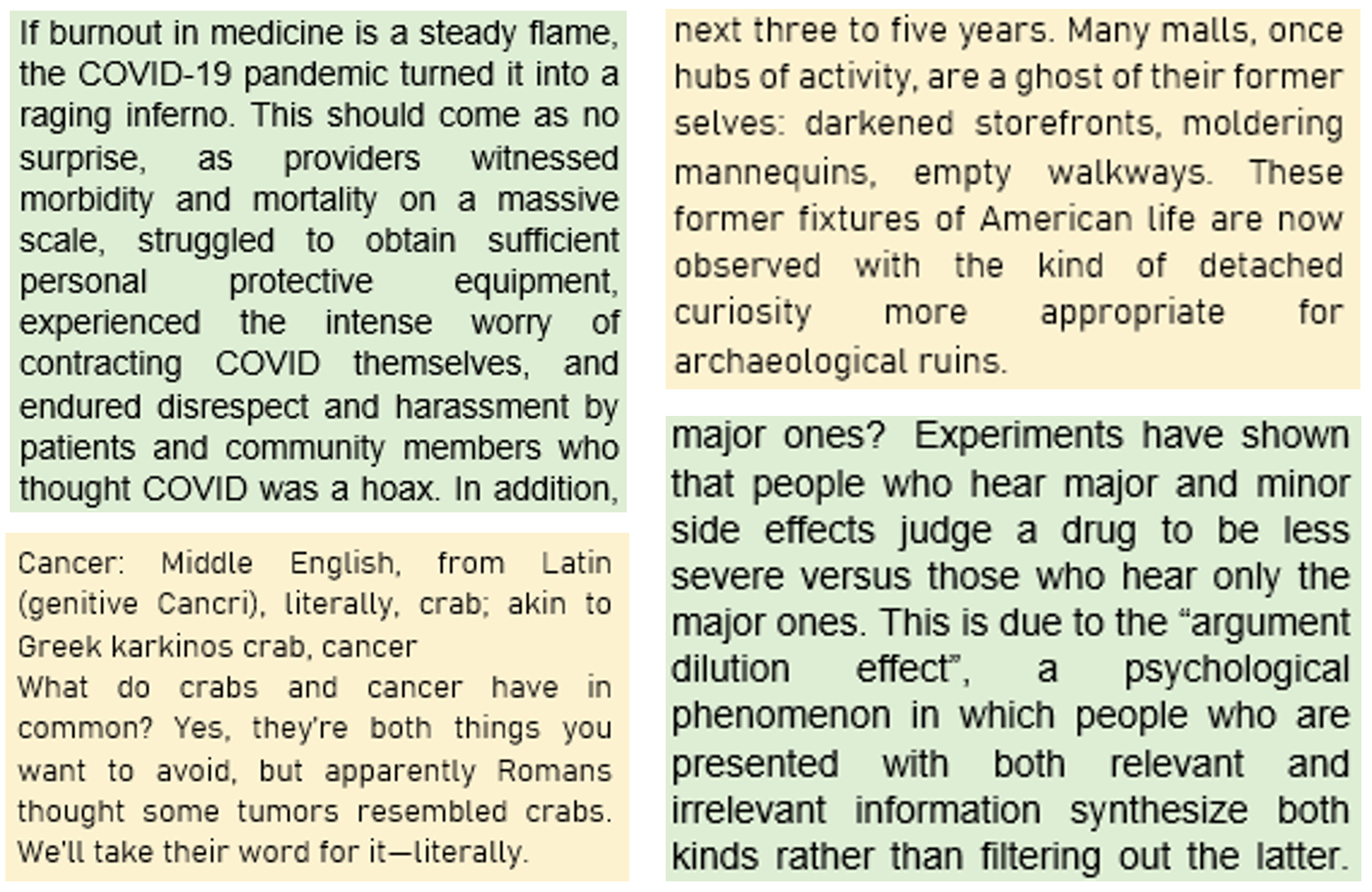
Figure 2. Snippets of My Writing Published in COM Chronicles Newsletters.
Clockwise from top right: “So Long, Malls,” fall 2022; “The Television Pharmacy: Everything You Need to Know about Prescription Drug Advertising,” spring 2023; “Medymology: The Fascinating Origins of Medical Terms,” fall 2022; “Running on Empty: The Toll of Burnout,” spring 2023.
My engagement with COM Chronicles is driven by the desire to make readers’ taste buds rejoice, but it’s not an easy task. I relate to what Stephen King frames as the writer’s torment, “the sense that you can never completely put on the page what’s in your mind and heart” (106). However, even if the meal ultimately falls short, I can keep what works, discard what doesn’t, and rewrite the recipe. Words are fickle and frustrating, but I’m not going to give up — I’m going to don my well-worn apron and whip them up into something special.
Ah, words. In them we hear the echoes of the past and the murmurs of the future. They hold our hopes, doubts, successes, and failures, marinated in culture and history. Like food, words transcend generations, stimulating, calming, challenging, and sustaining. Moreover, words are the building blocks of literacy. Although literacy is a multifarious concept, having mushroomed to refer to any type of competence, I do not forget that “literacy” is derived from littera, Latin for “letter.” Literacy by its traditional definition, and the facility with words it engenders, transfigures amateur cooks into master chefs. It brought Malcolm X from an undereducated prisoner to the spirited face of Black Nationalism, Sherman Alexie from an impoverished and underestimated Indian to an award-winning poet, and Stephen King from an unknown to a bestselling author many times over. It has brought me, a girl with a penchant for peculiar words, to…a girl with a penchant for peculiar words, except now she knows how to use them. The ink dries, the pages turn, the files close, even the toast-chair will probably be tossed in a junkyard someday, but the words — the words were here long before I, and they will remain long after I’m gone. In these fleeting moments I have the words in front of me, I aspire to read, spell, and write them as they are meant to be read, spelled, and written. As Liesel opines at the end of The Book Thief, “I have loved the words and I have hated them, and I hope I have made them right” (Zusak 528).
After all, I mustn’t burn the toast.
Works Cited
Alexie, Sherman. “The Joy of Reading and Writing: Superman and Me.” Writing about Writing: A College Reader by Elizabeth Wardle and Doug Downs. Bedford/St. Martin’s, 2011, pp.362-365.
King, Stephen. “What Writing Is.” On Writing: A Memoir of the Craft, by Stephen King, Scribner, 2020, pp. 103-107.
X, Malcolm, et al. The Autobiography of Malcolm X. Ballantine Books, 1992.
Zusak, Markus. The Book Thief. Alfred A. Knopf, 2006.
—
Maggie Sheridan is a sophomore Medical Sciences major at the University of Cincinnati on the pre-med track. She sees science and writing as modes of understanding the world, and she endeavors to increase her literacy in both. She is the editor-in-chief of COM Chronicles and has written several articles on medical etymology. Maggie would like to acknowledge Professor Gary Vaughn for his guidance in the writing of this essay.
 queen city writers
You must be logged in to post a comment.